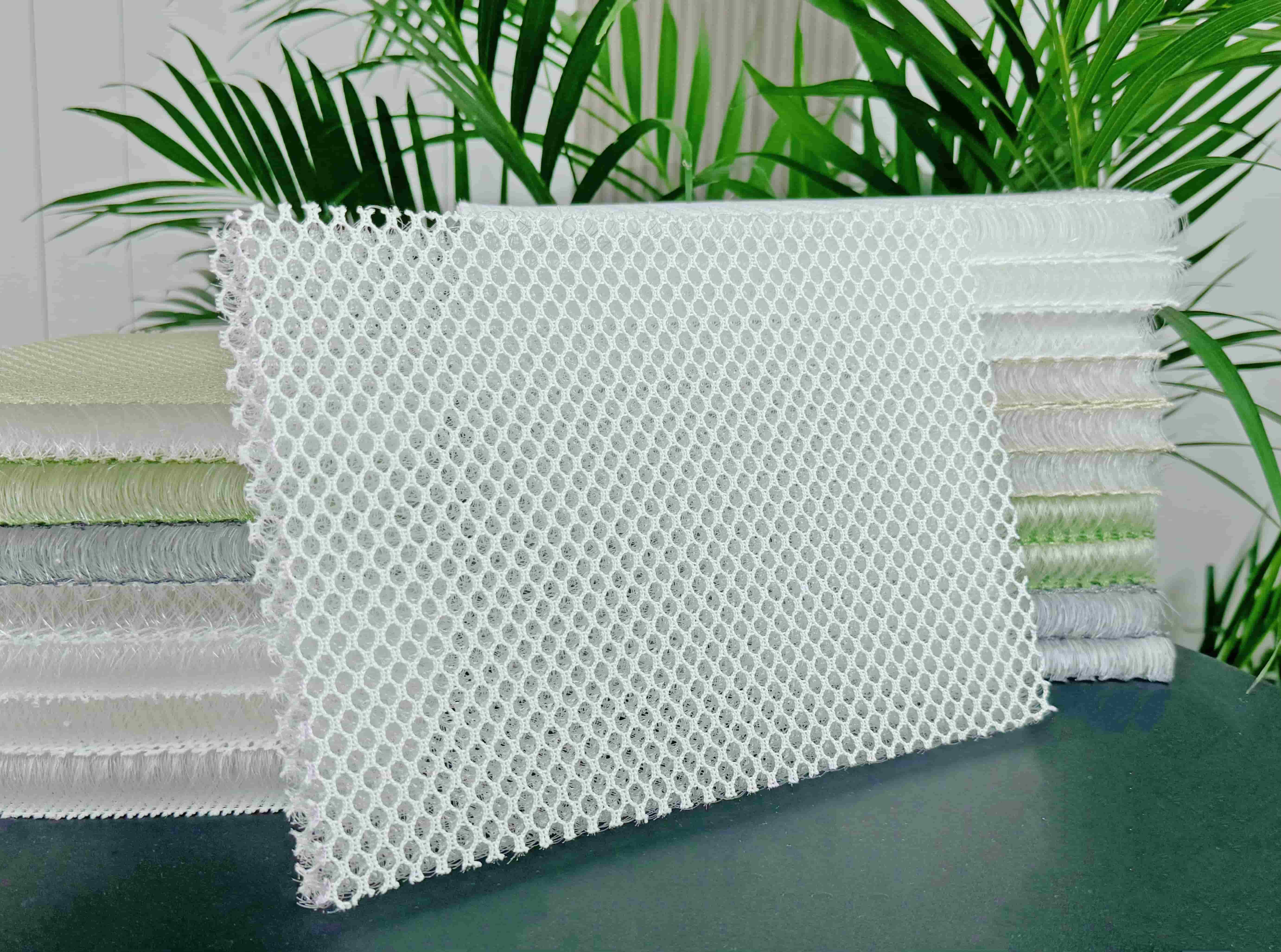
1. A Jacquard You Read by Texture, Not Colour
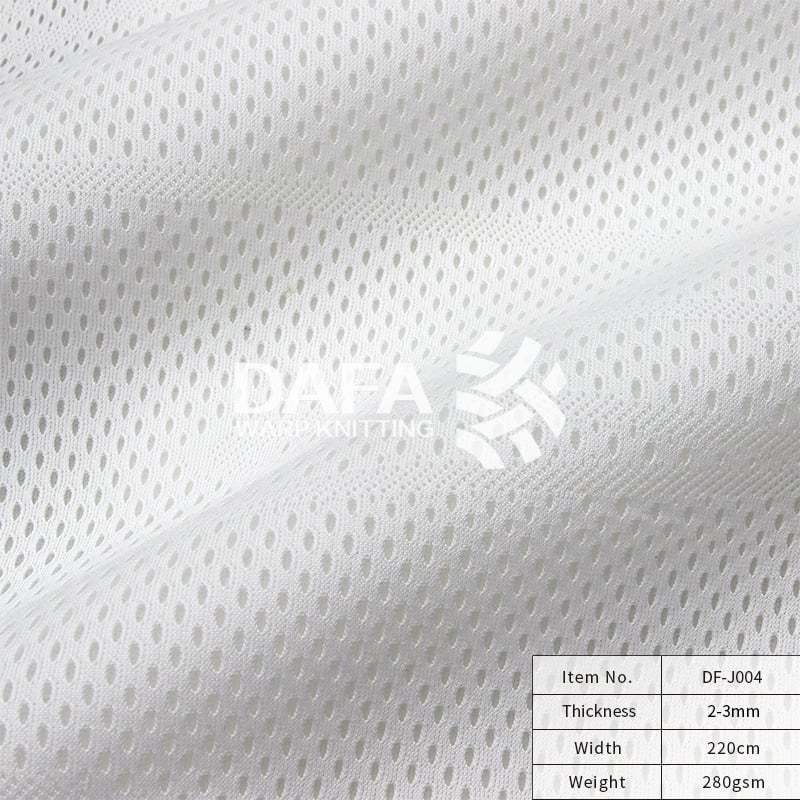
Jacquard usually means a colour pattern, and it can be: place coloured yarns by needle selection and a motif appears. This article works the other way round. Its Style is Jacquard but its Pattern is Dyed, so the whole roll leaves the dyehouse as one shade - and the design has to be visible with no colour difference to carry it.
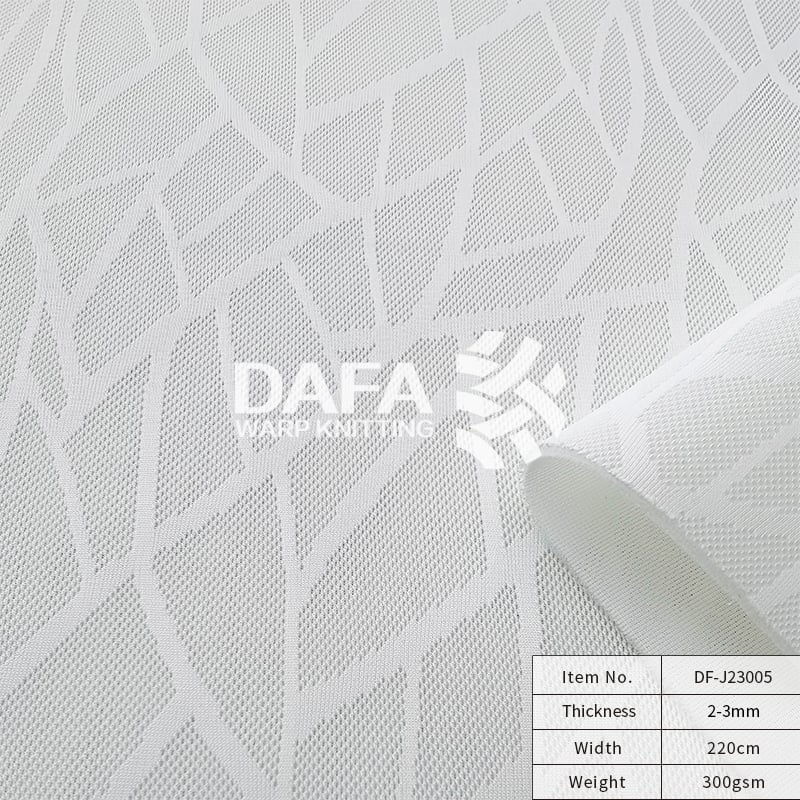
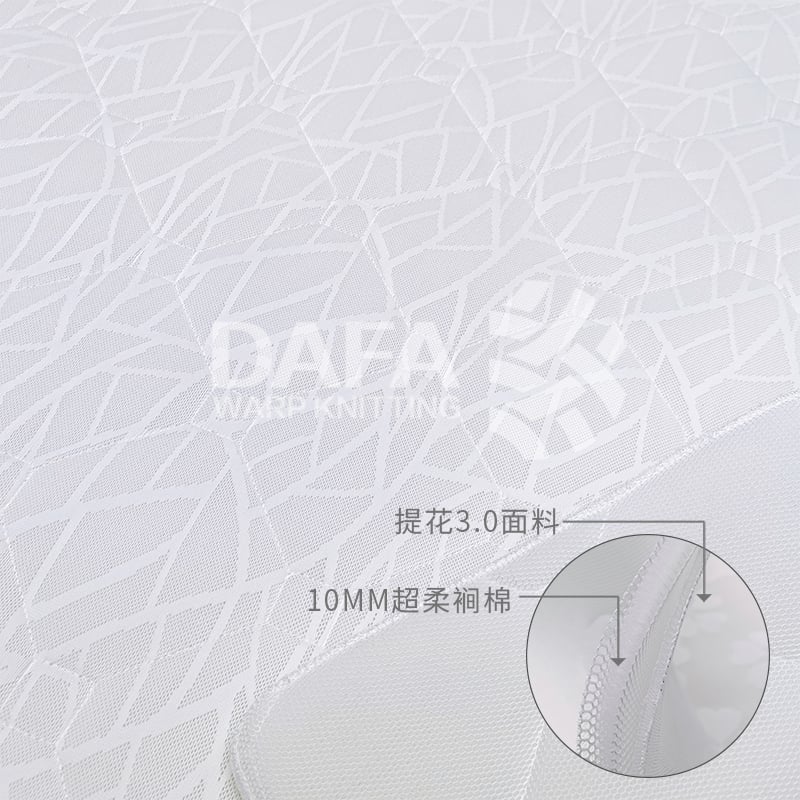
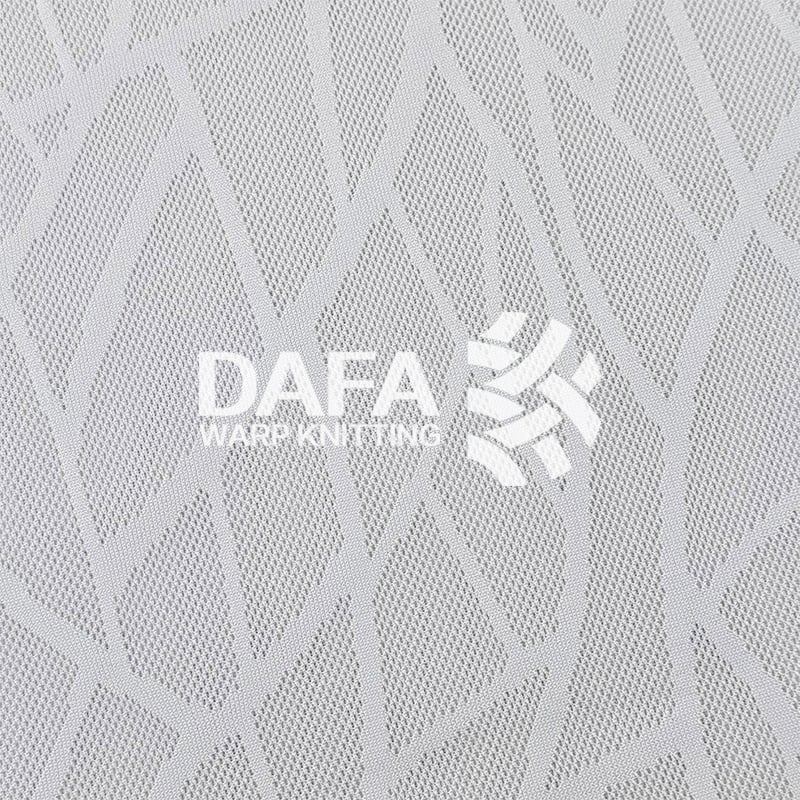
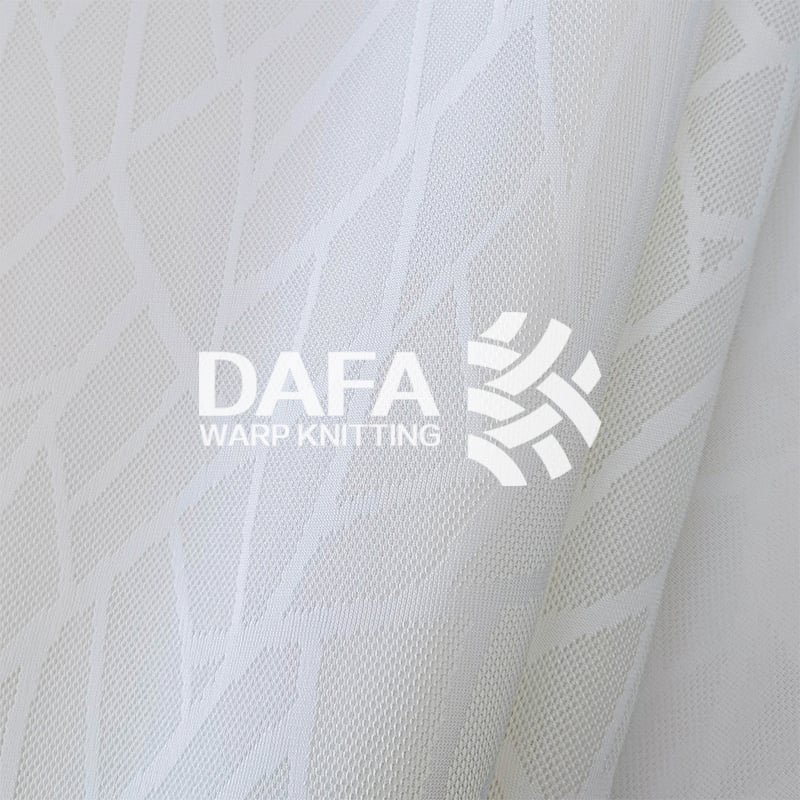
It gets there through the knit itself. Zones of the surface are knitted at different densities, so the cells close up in some places and open in others. Against a white ground the motif appears as relief: it catches light where the mesh is dense and reads flat where it is open, which is why the pattern in the photographs fills the fabric as a large tone-on-tone figure.
For bedding or cushion programmes that is often exactly what is wanted - a surface that carries visible design without competing with a print or a brand colour.
One consequence is easy to overlook: because the motif is made of density, the pattern doubles as a performance map. Where the mesh closes up, the panel is stronger, less breathable and more opaque; where it opens, air moves more freely and more light passes through. A jacquard repeat therefore leaves a surface with a built-in gradient, which is useful when a cover has to be firmer in the middle and more open towards the edges, or when part of a decorative panel also has to screen what sits behind it.
2. Interlining: the Third Use on the List
The attribute table names three uses - interlining, bedding and cushion. Interlining is the least obvious and the most specific. It is the layer that sits between a face fabric and its lining, never meant to be seen, there to add body, stop the face sagging and keep air moving behind it.
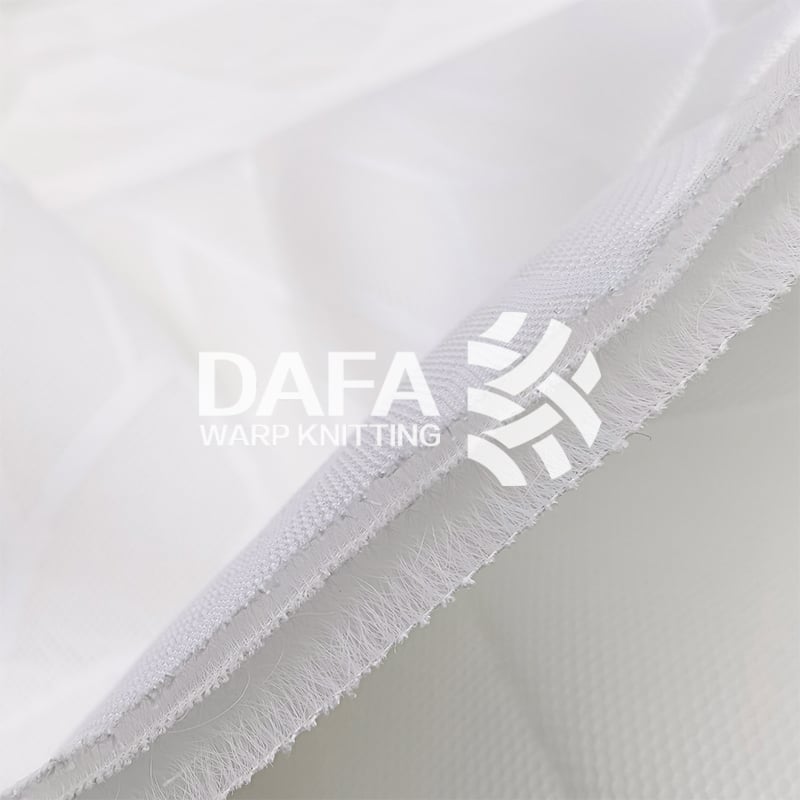
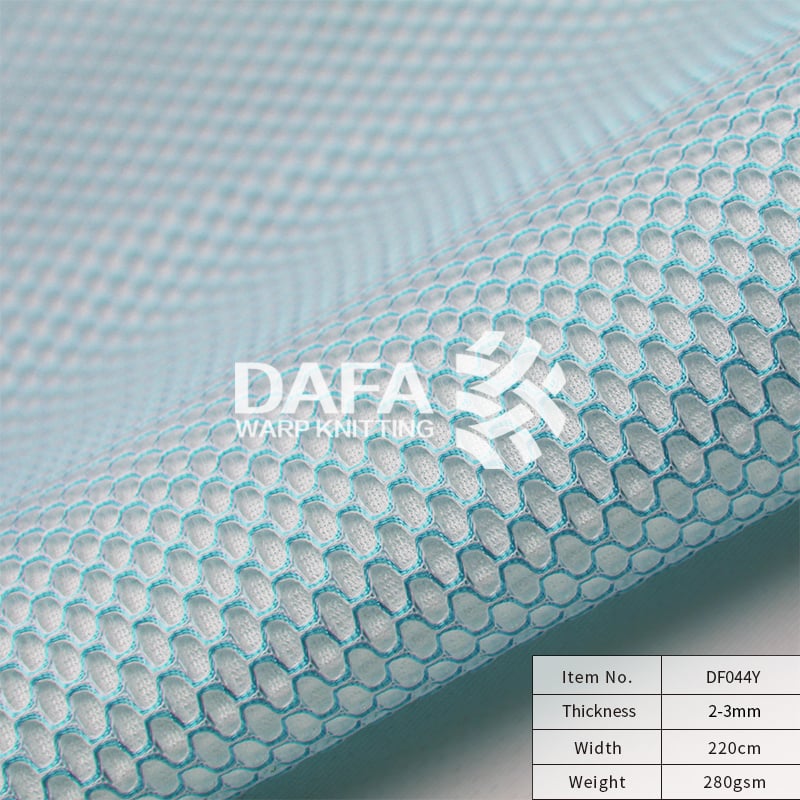
A 3D mesh fits that job because it is mostly air held in shape. Two millimetres of open structure gives a panel enough thickness to do something, without the weight that foam or wadding would add at the same thickness.
3. Cushioning, and What a Cover Has to Do
The title describes the article as a cushion cover, and the introduction calls the structure cellular with cushioning support. A mesh used over a cushion has a slightly different job from one used under a sleeper: it must flex with the core through thousands of cycles without going slack, and it has to let the core breathe.
Open cells do both. Air travels through the cover instead of being trapped between cover and foam, which is the usual reason a cushion runs hot.
4. One Shade per Run, Piece Dyed
Pattern is Dyed rather than Yarn Dyed, and the difference is commercial as well as technical. In a yarn dyed cloth the shade is fixed at the yarn, which suits repeat orders but commits you to coloured yarn before knitting starts. Piece dyeing colours the finished cloth, so a natural roll is dyed to a single shade and the jacquard comes through as structure.
The consequence is one shade per run, matched to a swatch. If your design needs a two-colour jacquard, say so - that is a different construction and it is quoted separately.
5. Technical Data
Item |
Value |
Model Number |
DF-J23005 |
Material |
100% Polyester |
Construction |
Warp knitted jacquard 3D mesh - pattern formed by varying knit density, nothing printed |
Weight |
300 g/m² |
Thickness |
2 - 3 mm |
Width |
220 cm |
Colour |
Dyed to a single shade; white shown |
Listed Features |
Breathable, anti-pill, anti-bacteria, eco-friendly, quick-dry |
Listed Certification |
None stated on this listing - please see the note in section 7 |
Supply Type |
Made to order |
Place of Origin |
Jiangsu, China |
6. Typical Uses
- Cushion covers, where a patterned and breathable surface is wanted.
- Mattress covers and protective bedding panels.
- Interlining layers that need body without weight.
7. Certification: What This Article Does and Does Not Carry
The attribute table on this page has no certification field, so we do not imply a certificate the listing does not state. What the company can document is at plant level: quality management (ISO 9001), environmental management (ISO 14001) and occupational health and safety (ISO 45001), with IATF 16949 in scope where an automotive application arises, plus annual Walmart and Sedex social audits.
If your market requires a restricted-substances certificate on the fabric itself, raise it at enquiry stage. We will confirm what can be issued for the shade and finish you actually order rather than assume it.
8. The Manufacturing Behind It
Piece dyeing is a dyehouse operation, and ours sits with the knitting floor - which is what lets a shade be matched and repeated without sending rolls out. Every stage is on one site: warping, knitting, dyeing, finishing, sewing.
The machine base runs past 250 double needle bar frames in gauges G12 to G28, over eighty of them from KARL MAYER, including the RDJ5-1 jacquard model used for patterned spacer work. Output is around 900 tons a month.
9. Ordering
DF-J23005 is made to order. Tell us the shade, the width, and whether the jacquard motif needs to be yours or one of ours. Terms of payment and packing are listed under Ordering & Terms on this page.
10. Buyer Questions
Is the pattern printed onto the fabric?
No. It is knitted, by varying the structure across the width, so there is no ink layer to wear, crack or fade.
Can the motif be our own design?
Yes, within the repeat the frame can carry. Send the artwork and we will confirm the repeat, the density changes it needs and the setup cost.
Does this article carry OEKO-TEX?
The attribute table does not list a certification for it, so we do not claim one. Tell us the standard your market requires and we will confirm what documentation can be issued for your order.
How much does the pattern reduce airflow?
It varies across the repeat rather than acting as one figure. Dense zones hold air and light back, open zones do not, so the average lands between a plain mesh and a closed knit. Tell us which area of the panel matters and we will measure that build instead of quoting an average.
11. Contact
Send the shade and width you need, plus the standard your market applies, and we will come back with a costing, a sample and the technical data.
Changshu Dafa Warp Knitting Co., Ltd.
No. 18 Longteng Road, Changshu City, Suzhou City, Jiangsu Province, China
Tel: +86-0512 52669012
E-mail: [email protected]t
 EN
EN