 EN
EN

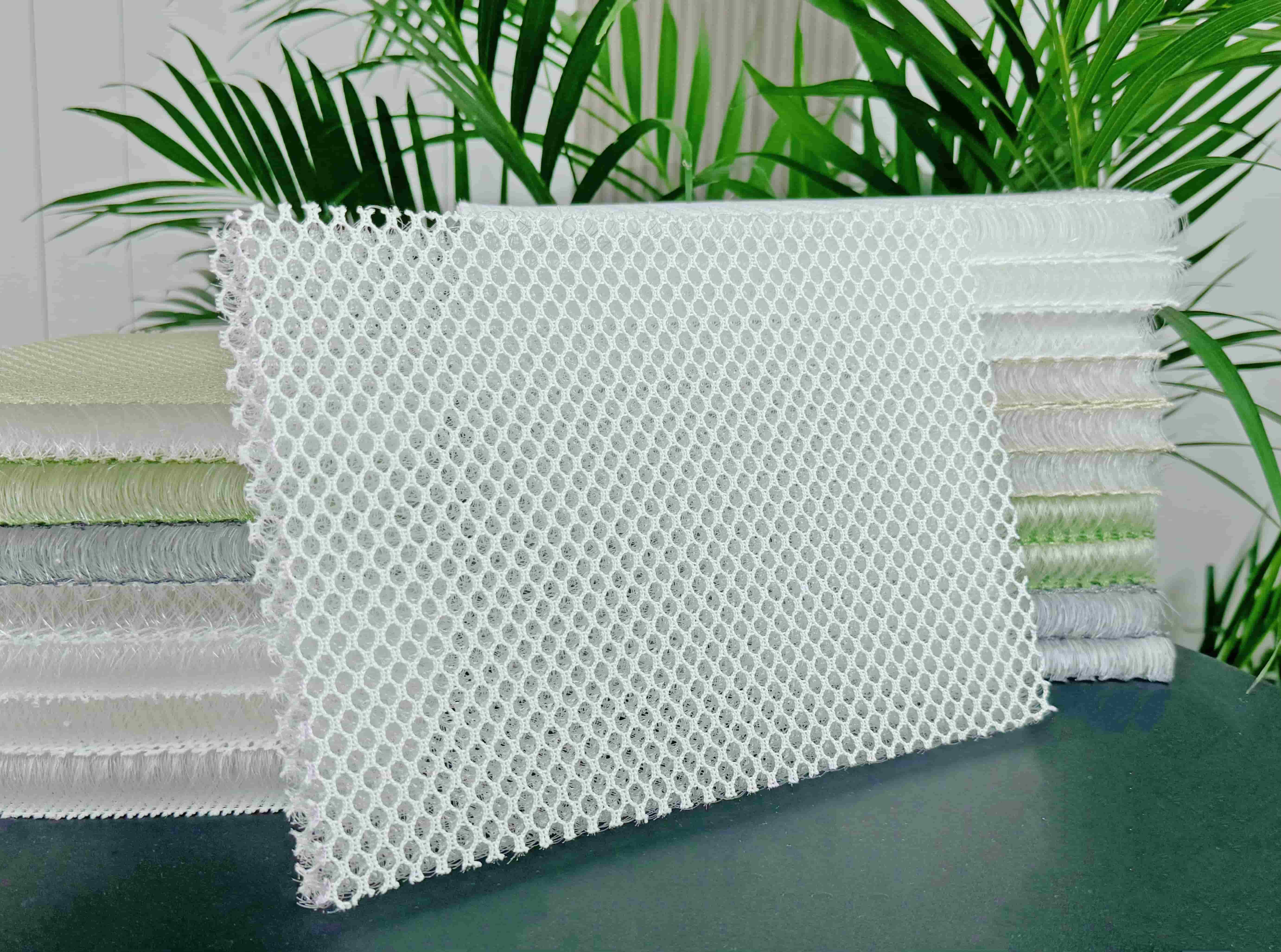
3D Spacer Fabric - 3D Air Mesh Mattress Inner Core Material Polyester Warp Knitted 3D Mesh Fabric for Mattress Cores and Pillows
Most of the mesh we knit ends up on the outside of a product, where the buyer sees it. This article does the opposite job. At 1,100 g/m2 it is one of the heaviest structures in our range, and it is filed in the 20 to 40 mm band - the group we build for mattress cores, thick cushioning layers and pillow interiors.
- Overview
- Recommended Products
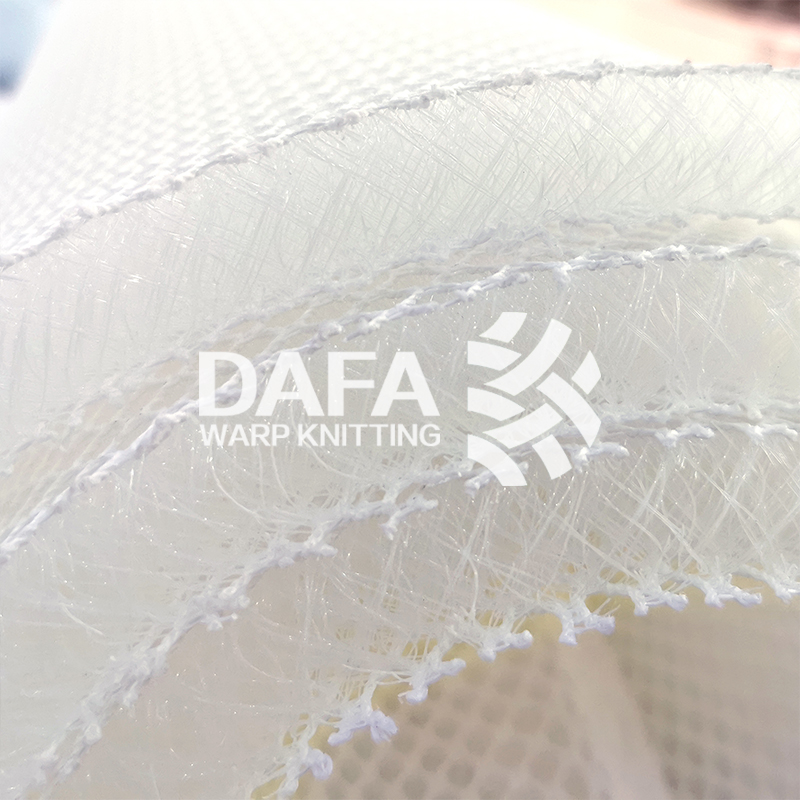
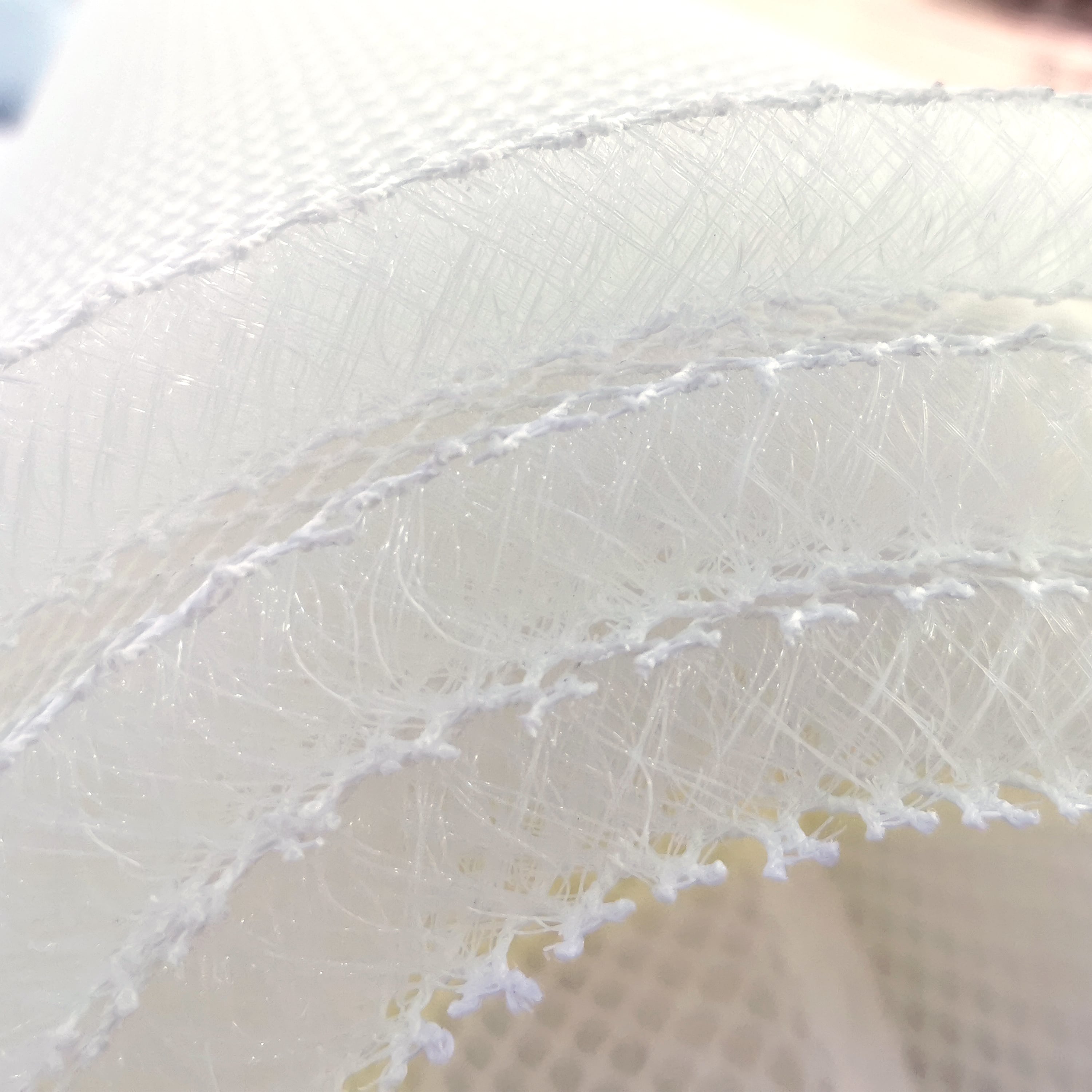
- Hold its thickness under load. The vertical monofilaments between the faces act as thousands of short columns: they compress under weight and return when it is lifted, which is what stops a mattress developing a hollow.
- Let air and moisture move. Because the pile holds the faces apart, a continuous air path runs through the thickness of the fabric in every direction, so heat and vapour pass through the core rather than collecting in it.
- Stay light for its volume. A high pile built from monofilament is mostly air, so a thick core does not make the mattress hard to handle.
- Survive the build. The core is compressed, cut, glued and sometimes washed. A knitted structure tolerates that handling without fraying away from a cut edge.
- Core layer between the support base and the comfort layer, supplying ventilation and resilience.
- Beneath a foam or latex comfort layer, where trapped heat is what limits sleep comfort.
- Border and side-wall applications, where the core must hold shape as well as breathe.
- Pillow interior, replacing a solid filling with one that moves air.
- Topper cores, where a thick but light middle layer is wanted.
- Weight in g/m2, and the thickness you want inside the 20 to 40 mm band.
- Roll width, or whether the core should arrive as cut sheets.
- Cell pattern, where hand feel or drainage has to be tuned.
- The compression behaviour your finished mattress must meet, so the build can be matched to it.
- Colour, and whether the core will ever be visible in the finished product.
- Packing and roll length, if the core is fed straight onto your line.
- Fabric certification - OEKO-TEX STANDARD 100 for the range, retested annually; normally the certificate a bedding retailer requests first.
- Quality and environmental systems - ISO 9001 and ISO 14001, with ISO 45001 covering occupational health and safety.
- Automotive quality - IATF 16949, where the same fabric is destined for a vehicle interior rather than a bed.
- Social compliance - Sedex and Walmart audits, carried out at the plant each year.
1. A Different Job: the Core, Not the Cover
A core is judged differently from a cover. Nobody looks at it, so surface appearance is beside the point. What matters is that it holds an even thickness under a body over years of use, that air moves through it rather than sitting inside it, and that it does not crumble, pack down, or take a permanent memory of whatever pressed against it.
2. Four Things a Core Has to Do
Seen that way, a mattress core has four obligations, and the spacer construction answers each of them differently.
3. Why 20 to 40 mm Changes What the Fabric Is
At two or three millimetres, a spacer mesh is a facing material: it supplies airflow and texture, but the foam or wadding beneath carries the load. Past twenty millimetres the fabric becomes a structure in its own right - the pile height is the cushioning, and the fabric can replace a layer rather than merely cover one.
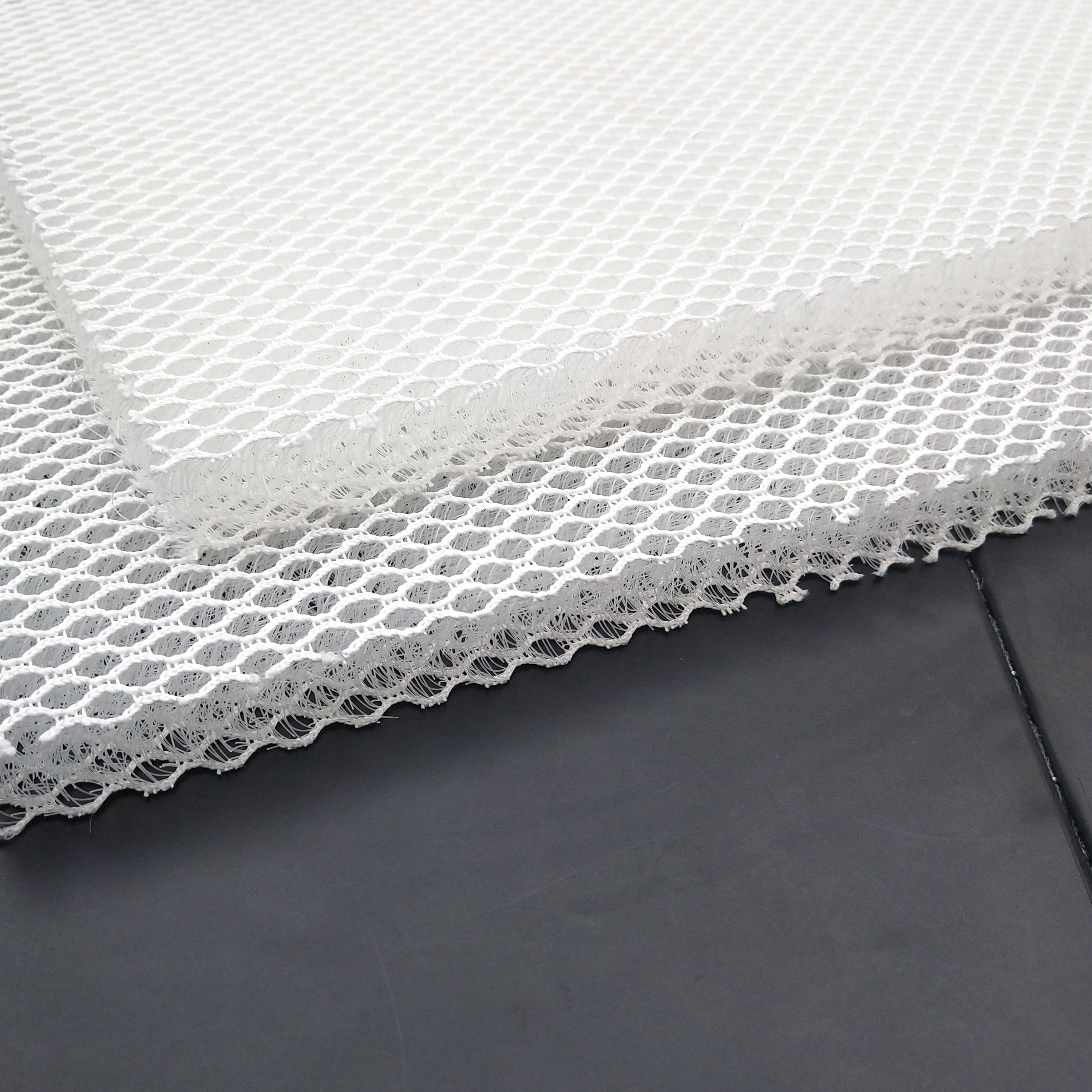
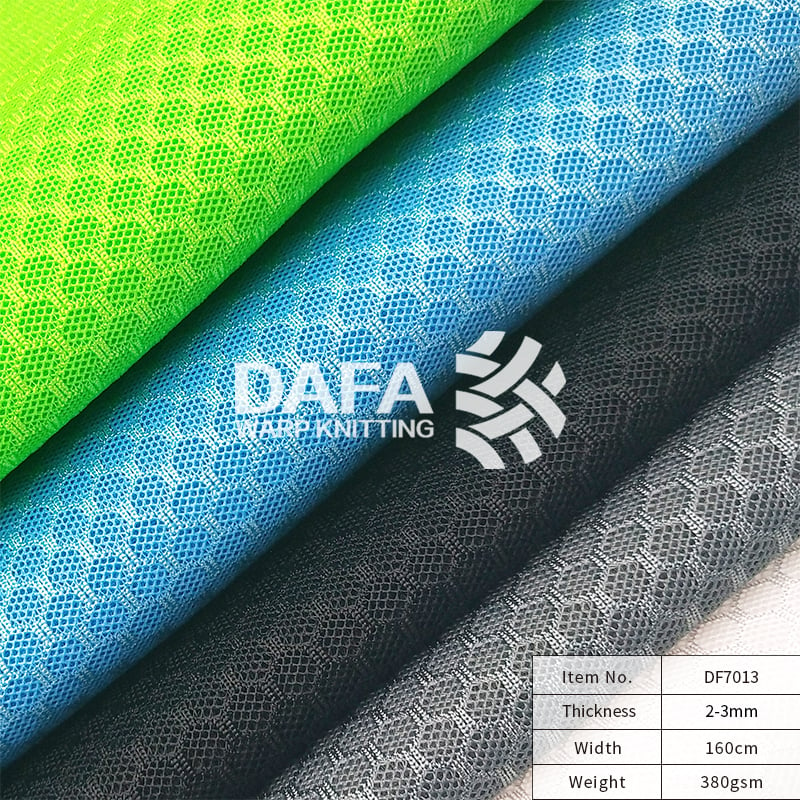
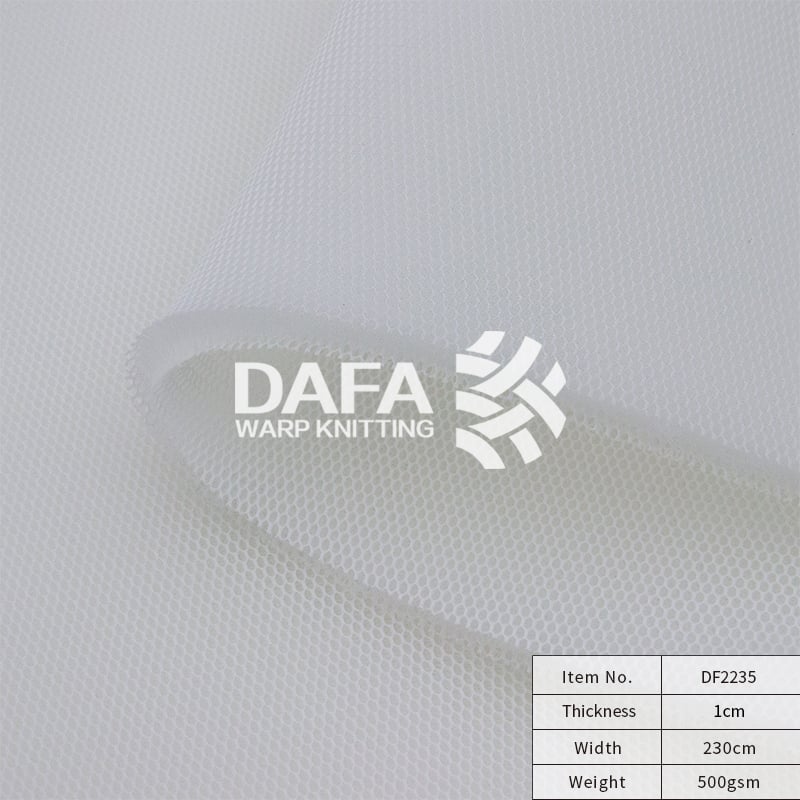
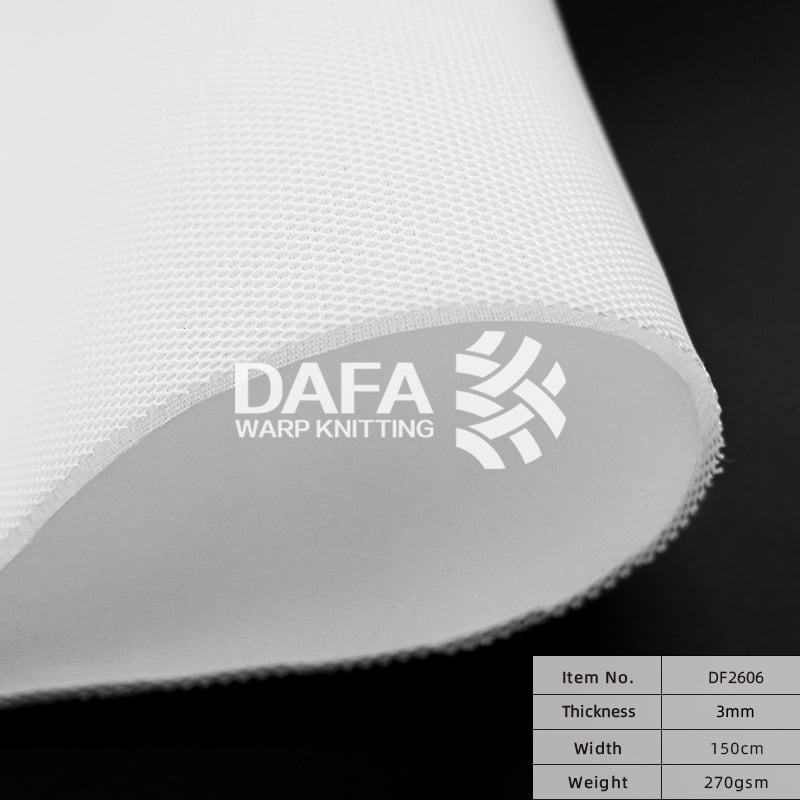
Cell geometry matters at this scale. The articles in our gallery show hexagonal and rectangular cell patterns, and the pattern governs how the pile behaves: how it feels under a hand, how it drains when washed, and how it responds to compression.
4. Specification
Item |
Value |
Model Number |
DF-N-2020W23 |
Material |
100% Polyester (per the article title) |
Weight |
1,100 gsm |
Thickness band |
20 - 40 mm range (filed under this category) |
Construction |
Warp knitted 3D spacer, three layers: two knit faces joined by vertical monofilament pile |
Cell geometry |
Hexagonal and rectangular cell patterns available, per the build |
Listed Features |
Breathable, eco-friendly, quick-dry |
Recommended Use |
Mattress cores and pillow interiors |
Width |
Set with the order - please specify |
Colour |
White as shown; further shades developed with you |
Supply Type |
Made to order |
Place of Origin |
Jiangsu, China |
5. Where It Sits in a Mattress Build
6. What to Fix Before You Order
This article is built to specification, so a short list settled in advance saves a development cycle:
7. Paperwork and Compliance
Four sets of documentation cover this article:
Production records are kept at every stage, so any finished lot can be traced back to its knitting run.
8. The Manufacturing Behind It
The company behind this article has been knitting spacer fabric since 1993. Capacity runs to more than 250 double needle bar machines - models RD6, RD7, RDJ5-1 and High Distance, in gauges G12 to G28 - and 80+ of them are KARL MAYER units, working to roughly 900 tons a month. Nothing between yarn and shipment is outsourced - dyeing, finishing and sewing all sit on our own sites, so a colour change or a width correction does not become a scheduling problem. Shipments leave regularly for Europe, the Americas, the Middle East and Asia.
9. Ordering
This article is built rather than stocked, so the specification is agreed before production begins. Commercial terms - minimum quantity, payment schedule, packing and paperwork - are listed in the Ordering & Terms section further down this page.
10. Questions Mattress Buyers Ask
How does a knitted core compare with a moulded one?
The difference shows up over time rather than on the first day. A knitted structure compresses and recovers repeatedly instead of taking a set, and it keeps an air path through its full thickness, which a solid moulded core cannot.
Can the thickness be tuned to our mattress build?
Yes. The article sits in a 20 to 40 mm band, so pile height is a specification rather than a fixed value. Tell us the thickness and compression behaviour your mattress is designed around, and we will match the build to it.
Will it survive being washed?
The construction drains readily and dries quickly, which is one reason it appears in washable programmes. Wash behaviour still depends on the finishing route, so please confirm your protocol with us before bulk production.
11. Contact
Send us the thickness, weight and roll width you need, together with the mattress build it has to fit, and we will confirm the specification, pricing and a sample.
Changshu Dafa Warp Knitting Co., Ltd.
No. 18 Longteng Road, Changshu City, Suzhou City, Jiangsu Province, China
Tel: +86-0512 52669012
E-mail: [email protected]t